
VAST Data Turns to Solidigm to Displace Hard Drives
VAST Data and Solidigm displace HDDs with dense, efficient storage to unlock the power of your data, as AI data demands shake up storage tiering.
Phil Manez of VAST Data explains how AI workloads have created a data center environment where traditional tiering of data is no longer a workable solution. VAST Data has turned to dense storage media from Solidigm to meet the demands of its customers’ data storage needs.
TCO is now the main focus for investing in storage instead of outdated acquisition cost consideration alone, with Solidigm SSDs delivering up to 58% reduction in TCO compared to HDDs over their lifetime.
Power is a primary constraint in the data center which makes spinning disks untenable compared with denser, less power-consuming SSDs — with up to a 75% reduction in power consumption compared to HDDs.
Reducing or eliminating GPU idle time is key to RTO. SSDs are the answer to keeping GPUs utilized. HDDs just can’t keep up with the data demands of AI factories to unlock the value in all your data — cold, warm and hot — which necessitates fast access media like SSDs.
VAST Data, with Solidigm SSDs, is the future of the AI data center with dense, efficient capabilities to unlock the power of your data.
For the last decade, the consensus across the industry has been that the most efficient way to build data centers is leveraging tiering.
So the logic is that flash is expensive, disk is cheap, and only a little bit of our data is hot or active at any given time. But the introduction of AI has turned all of those assumptions that made tiering a good idea on their head.
I'm Phil Menez. I'm the Go To Market Execution Lead for VAST Data.
So one of the first assumptions that fell apart is that the main focus should be around acquisition cost because GPUs are consuming so much power that if I'm building a GPU powered data center, my number one constraint is power.
So I need to think about: How can I fit my capacity requirements into whatever power footprint is leftover after I've fed all of those GPUs?
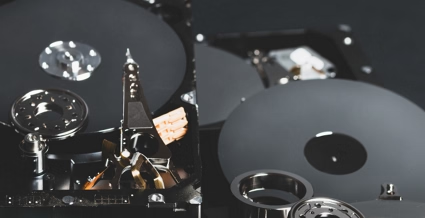
You cannot meet those requirements leveraging tiering and spinning disks.
The next piece is: GPUs are becoming the biggest investment that customers are making in their data centers, so the key is keeping those GPUs highly utilized. And if I have a GPU that needs to go to spinning disk to get data, it's going to wait. And that's going to kill my utilization and, ultimately, kill my investment in GPUs.
And then the final assumption is that I'm only going to be using a little bit of my data at any given time.
We've all been hoarding data for decades with the promise that one day we'll have the tools to unlock the value and the insights of that data. And that tool is AI. It's here. And if I truly want to unlock the value from all of my data, I have to put it all on fast access media, allowing AI to leverage it and being able to feed that data to those GPUs.
VAST and Solidigm are working together to solve these challenges for our customers.
When you combine VAST technology and efficiency with Solidigm high density SSDs, you get a 75% reduction in power, a 90% reduction in floor space.
Over the longer lifespan of these SSDs, we get a 58.9% reduction in TCO.
So if you take into consideration what AI needs to be successful, the tools that our customers need to unlock value and insights from their data, and the fact that tiering no longer makes sense economically, the future of the AI powered data center is VAST technology and Solidigm SSDs giving you dense, efficient capabilities to unlock the full potential of your data.