
It’s Time to Take the Path from Legacy Storage to NVMe
Learn how investing in modern NVMe-based storage can secure unmatched performance for core business applications and a more efficient IT footprint for the future.
Don’t be dis-SATA-sfied with your storage infrastructure
Let’s take a quick enterprise storage journey by thinking about how transportation has evolved.
- First came the pedestrian path — foundational and functional, but painstakingly slow.
- Then the horse, traveling those same paths at a pace that once seemed unthinkable. But horses were still bound by the same narrow, single-lane limitations.
- Then the automobile arrived — and soon after, the multi-lane freeway. The car wasn't just faster; it was operating on entirely different infrastructure, purpose-built for speed, scale, and parallel movement.
Your data center storage is at a similar crossroads. Hard disk drives established the footpath. The SATA eSSD horse rides those same roads - faster but still constrained by legacy pathways. The NVMe eSSD ‘car’ benefits from the multi-lane data pathways, purpose-built from the ground up for modern computing. The time has come to make the move to NVMe-based storage, before the supply chain makes the decision for you.
The new economics of storage
The most common reason IT leaders cling to SATA is perceived cost savings. However, that price gap has virtually disappeared, and price parity between SATA and NVMe on a per-gigabyte basis is now a reality.
Why has this happened? The global supply chain has moved on. Major storage manufacturers are winding down their legacy SATA production lines to allocate capacity toward products that better meet the performance and efficiency needs of modern enterprise storage workloads. As the supply of SATA components becomes increasingly scarce, prices for remaining new-old stock are actively rising. Buying SATA to "save money" is now a myth. In many cases, you are paying a premium for legacy technology.1
Doing more with less: Smart infrastructure consolidation
When you work with your IT reseller to transition to NVMe, you aren't just swapping out drives; you are upgrading to a vastly more efficient overall infrastructure. While this transition will require investing in modern servers and storage arrays designed for NVMe interfaces, such as systems with U.2 backplanes or tri-mode Host Bus Adapters, the performance and capacity leap means you will need to buy far fewer of them.
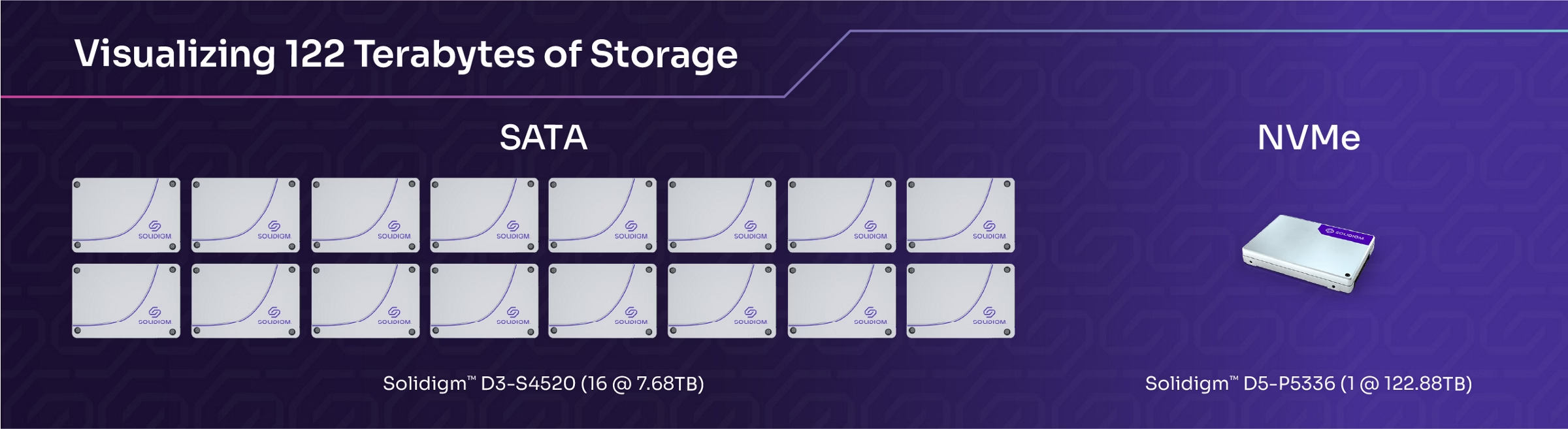
SATA interfaces cap out at around 600 MB/s, bottlenecking bandwidth through a narrow data pathway. By contrast, modern NVMe drives communicate directly with compute via the PCIe BUS and can reach speeds exceeding 7,000 MB/s, merging onto the freeway and leaving legacy storage in the dust. To put this in perspective, a single modern NVMe SSD can deliver the read performance equivalent of up to 12 SATA SSDs, or 28 HDDs.
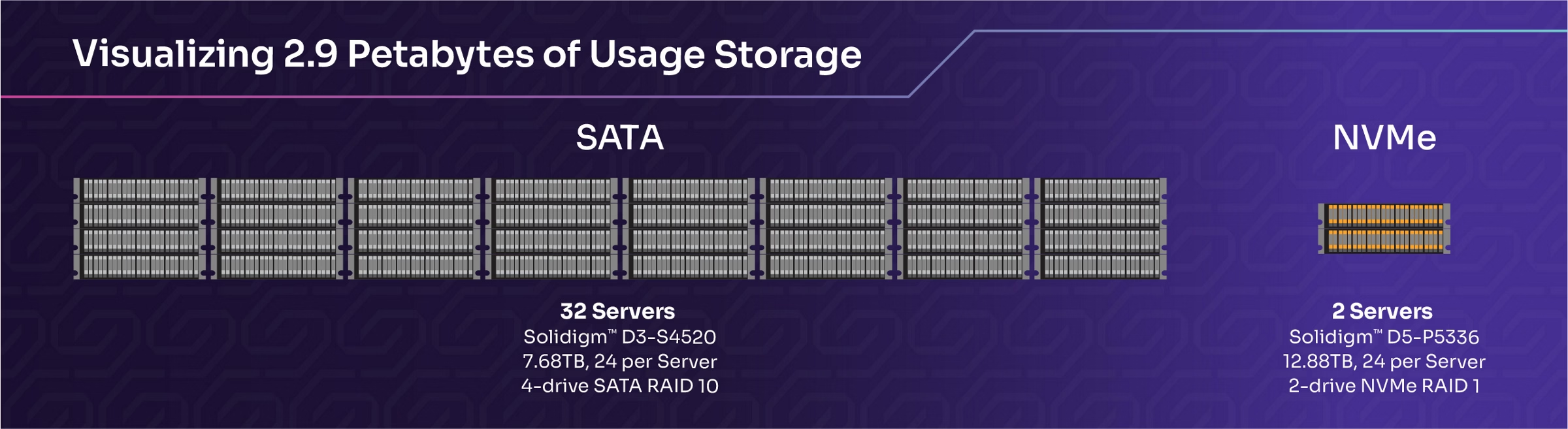
By working with your reseller to deploy NVMe-ready servers, you can reduce your hardware footprint. For example, moving from a standard 4-drive SATA RAID 10 configuration to a 2-drive NVMe RAID 1 setup maintains the exact same usable capacity while doubling your read bandwidth. When you consider the price parity between SATA and NVMe drives, the incremental costs of additional SATA server hardware and infrastructure—and even space—become extremely hard to justify.
Supercharge traditional workloads with NVMe
While artificial intelligence (AI) dominates the headlines today, the reality is that your traditional, everyday workloads stand to benefit from an NVMe upgrade.
The SATA protocol was originally built for spinning mechanical hard drives and engineered for the footpath era of storage. It uses a single command queue limited to just 32 commands. NVMe, on the other hand, was built natively for the parallel nature of flash storage, supporting up to 64,000 queues with 64,000 commands each. It's the difference between a single-lane dirt road and a 64,000-lane freeway, with traffic moving freely in every direction simultaneously.
For traditional read-heavy workloads like object storage, analytics and data warehousing, and backup and restore, this parallelism is a game changer.
- In S3-compatible object storage applications, for instance, NVMe can deliver 11x the read IOPS performance of a SATA eSSD.
- In backup and restore scenarios, the NVMe eSSD delivers nearly 6x the write bandwidth of SATA, enabling faster backup windows, faster restores, and fewer backup appliances.
These performance advantages translate directly to faster query responses, smoother virtual machine performance, and happier end-users.
| Metric | SATA 6Gbps | Solidigm D5‑P5336 | Improvement |
|---|---|---|---|
| Read Bandwidth (MB/s) | 540–560 | 7000+ | 12.5X |
| Write Bandwidth (MB/s) | 510–530 | 3000+ | 5.7X |
| Read IOPS | 80–90K | 900K–1M+ | 11X |
| Write IOPS | 30–60K | 25–40K+ | 0.67X |
Build your data infrastructure on a solid foundation
SATA SSDs are a dead-end road. Waiting until components are entirely unavailable could force emergency, expensive migrations. The only question is whether you merge onto it now, on your own terms, or find yourself stranded on a dirt path with no good options left.
As you plan your next data center refresh, engage your IT reseller to design a modern, NVMe-based infrastructure. By investing in modern NVMe-based servers and storage arrays today, you can secure unmatched performance for your core business applications, and a leaner, more efficient IT footprint for the future.
Dave Sierra is a Product Marketing Analyst at Solidigm where he focuses on solving the infrastructure efficiency challenges that face today's data centers.
SATA Premium – Several factors affect SATA TCO (Total Cost of Ownership) including the impact of constrained supply on pricing, increased operational costs through increased power consumption, and a larger physical storage footprint. Results will vary based on workload, deployment scale, and negotiated pricing.