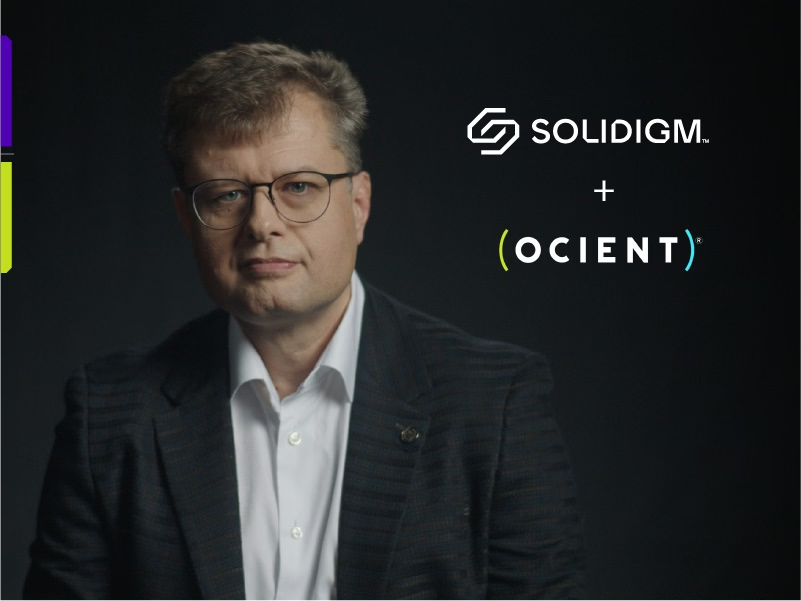
Ocient Director of Industry Partnerships and Alliances, Przemek Tomczak, dives into how AI workloads are upending traditional data center infrastructure. Moving data over networks is no longer fast enough to keep GPUs busy. To keep energy costs, system footprint, and resource use low, organizations need solutions that helps them access data where it lives.
Solidigm SSDs enable Ocient to do just that. By using Solidigm high-capacity drives, available in 32TB, 64TB, and 122TB capacities, Ocient stores and accesses petabyte-scale data in milliseconds, delivering better performance, cost, and energy efficiency than other solution providers on the market today can.
We work with Solidigm to pick the right technology for the customer's workload and support their journey with the least amount of infrastructure.
We are all living at a time where data center space is at a premium. Companies are investing to deploy AI infrastructure and GPUs that are power hungry. If you can reduce infrastructure footprint [and] energy consumption, you're enabling the business to take advantage of building modern applications and not have to wait. My name is Przemek Tomczak and my role at Ocient is Director of Industry Partnerships and Alliances.
Ocient is a modern data [intelligence] platform delivering better performance at lower cost and energy efficiency than anything else out there on the market.
AI workloads are changing how applications, users, and agents are interacting with modern data infrastructure. Systems built on hard disk and traditional architectures are feeling the strain. While they can't support the level of concurrent access, queries, analytics. And that access requires access to a lot more data than ever before.
The way traditional stacks support always-on compute-intensive workloads is by using a lot of infrastructure. Thousands of servers [are] copying the data multiple times because if a part of the infrastructure has some challenges, work will be redirected to a copy. As the data sets evolve to hundreds of terabytes, multi petabytes that does require hundreds and thousands of servers that consume power, that consume resources, and that's costly.
Ocient's approach is to bring compute much closer to where the data actually is. So that means that your request is completed much faster because you're not having to have compute interacting with where the data is stored over networks. We have a revolutionary way of how to store this data on modern NVMe storage using erasure coding and that avoids duplicating [or] triplicating data. And with advanced compression indexing we don't need as much resources for better performance and at lower cost.
Solidigm produces some of the highest performing, highest density solid-state drives. That translates into everything lower: energy cost, rack footprint. I give the example of working with one tier; one operator. We help reduce 5 racks of servers and infrastructure wiring down to just one. And that's significant. Something that would have required hundreds of thousands of servers is done in a smaller footprint and working with Solidigm we're able to put over a petabyte of data in a single server.
And what that translates is to be able to ask much more, tougher, challenging questions at the lowest cost and lowest energy use than ever before. Solidigm produces 30TB and 122TB SSDs, so putting that into an infrastructure allows you to store and access a lot more data in milliseconds.
We work with Solidigm to pick the right technology for the customer's workload and support their journey with the least amount of infrastructure.
Subscribe for product updates, technical resources, and insights on accelerating AI workloads with Solidigm Storage